


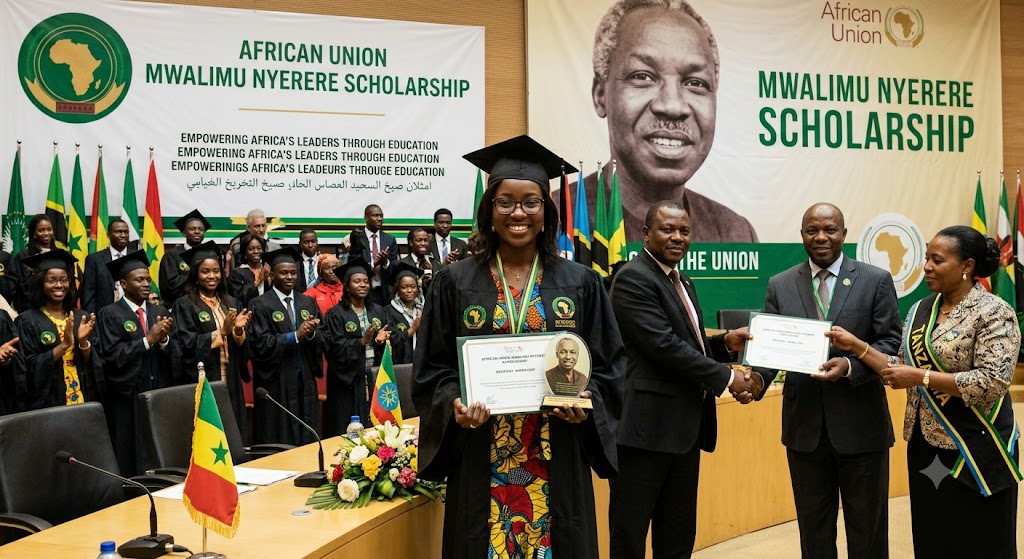
African Union Mwalimu Nyerere Scholarship 2026: Fully Funded Scholarships for Africa
The African Union Mwalimu Nyerere Scholarship is a fully funded scholarship for African scholars. Sailing in the landscape of higher education in Africa can be both exhilarating and challenging for ambitious young minds. For many brilliant students across the continent, financial constraints often stand as a barrier to achieving academic excellence. The barrier prevents talented scholars from contributing meaningfully to regional development. The African Union Commission has launched an initiative to support the continent’s most promising minds.
The African Union Mwalimu Nyerere Scholarship stands as a beacon of hope, opportunity, and academic distinction. The scholarship is named in honor of one of Africa’s most revered founding fathers, visionaries, and educators; Mwalimu Julius Nyerere. This scholarship scheme is dedicated to advancing knowledge, fostering innovation, and driving sustainable development across the continent. By providing comprehensive financial support, this initiative enables top-tier African students to pursue life-changing postgraduate studies.
This comprehensive guide offers an in-depth exploration of the African Union Mwalimu Nyerere Scholarship. It details everything you need to know from eligibility requirements and coverage values to strategic application steps. If you are an academic African youth eager to transform your future and lead the continent’s socio-economic renaissance, this ultimate guide is your roadmap to securing one of the premier fully funded scholarships for Africa.
Details of the African Union Mwalimu Nyerere Scholarship
To give you an immediate, clear snapshot of what this incredible opportunity entails, here is an executive summary of the program:
-
Name of the Initiative: African Union Mwalimu Nyerere Scholarship Scheme (AUMNSS)
-
Funding Body: The African Union Commission (AUC)
-
Coverage Type: Fully Funded Scholarships for Africa (covering tuition, living stipends, travel, and books)
-
Target Audience: Young African students, academic African youth, innovators, and future researchers
-
Eligible Regions: All citizens of African Union Member States
-
Levels of Study: Postgraduate programs, specifically Master’s (MSc/MA) and Doctoral (PhD) degrees
-
Priority Fields: Science, Technology, Engineering, Mathematics (STEM), Agriculture, Health Sciences, Education, and Sustainable Development
-
Host Institutions: Accredited, high-performing African Universities outside the applicant’s home country to promote intra-African student mobility
The Indepth Information of the African Union Mwalimu Nyerere Scholarship
The African Union Mwalimu Nyerere Scholarship is a strategic investment in human capital managed by the Department of Education, Science, Technology, and Innovation (ESTI) of the African Union Commission. The core philosophy of this scheme revolves around the concept of “pan-Africanism through education.” It encourages students to study in countries other than their own within the continent. In addition, the program fosters deep cross-cultural understanding, breaks down national silos, and builds a robust, interconnected network of African experts.
Historically, Africa has faced a significant challenge known as the “brain drain,” where highly talented individuals leave the continent to pursue higher education and career opportunities abroad, often never returning. The African Union deliberately designed this scholarship to stimulate “brain circulation” within Africa. By keeping talent on the continent and training scholars in regional contexts. Moreover, the program ensures that research, innovations, and problem-solving methodologies remain directly applicable to African realities.
Furthermore, the scholarship aligns seamlessly with the goals of the African Union Agenda 2063, the continent’s strategic framework for socio-economic transformation. Agenda 2063 emphasizes the critical need for a skills revolution, particularly in science and technology, to propel Africa into a knowledge-based economic powerhouse. The African Union Mwalimu Nyerere Scholarship serves as one of the primary vehicles for delivering this skills revolution. It prioritizes academic disciplines that have a direct impact on infrastructure development, food security, disease eradication, and industrialization.
The Scholarship Value and Financial Coverage
By fully funded scholarships for Africa, we mean that it provides total peace of mind, allowing scholars to focus entirely on their research and coursework without the stress of financial insecurity. The financial package is comprehensive and designed to mirror international scholarship standards.
-
Full Tuition Fees: The scholarship covers the complete cost of tuition and mandatory registration fees directly to the host African university for the entire duration of the approved academic program.
-
Monthly Living Allowance: Scholars receive a generous monthly stipend designed to cover accommodation, food, utilities, and daily local transportation. This stipend is adjusted relative to the cost of living in the specific host country.
-
Travel Costs: The program provides an economy-class return air ticket from the scholar’s home country to the host country at the start of the program, along with a return ticket upon successful completion of the studies.
-
Book and Learning Materials Allowance: A dedicated annual allowance is disbursed to help students purchase text books, access academic journals, and acquire essential software or learning instruments.
-
Medical Insurance: Comprehensive health and accident insurance coverage is provided to ensure students have access to top-tier medical facilities during their time abroad.
-
Establishment Allowance: Upon arriving in the host country, a one-time settling-in allowance is given to assist students with initial expenses, such as securing housing and acquiring essential household items.
-
Dissertation and Research Grant: For both Master’s and PhD candidates, the scholarship provides dedicated funding to support fieldwork, laboratory experiments, data collection, and thesis production.
Expected Knowledge and Skills
The expectations placed upon recipients of the African Union Mwalimu Nyerere Scholarship extend far beyond maintaining high grades. The African Union Commission envisions these scholars as change agents, researchers, and policymakers who will steer the continent’s future.
Scholars are expected to develop advanced, specialized technical knowledge in their chosen fields. Whether mastering complex engineering algorithms, conducting cutting-edge biomedical research, or developing sustainable agricultural models, candidates must demonstrate academic rigor. The learning environment is structured to promote critical thinking, scientific inquiry, and evidence-based problem-solving.
Beyond technical expertise, the scholarship emphasizes the acquisition of broader leadership, management, and professional skills. Students are expected to gain competence in research methodology, scientific writing, and project management. Because scholars study in multi-cultural environments alongside peers from diverse African nations, they develop profound cross-cultural communication abilities, diplomacy skills, and a deeply rooted Pan-African mindset that prepares them for collaborative, continent-wide initiatives.
The Targeted Countries
A defining attribute of the African Union Mwalimu Nyerere Scholarship is its absolute commitment to geographical inclusivity and equity. The program is explicitly designed to benefit all fully funded scholarships for Africa seekers across the entire continent, ensuring that no region or country is left behind.
Eligible applicants must be citizens and residents of one of the African Union Member States. This encompasses countries across all five main geographical regions of the continent:
-
North Africa: Including countries such as Algeria, Egypt, Libya, Morocco, Mauritania, and Tunisia.
-
East Africa: Including nations like Kenya, Tanzania, Uganda, Ethiopia, Rwanda, Burundi, South Sudan, Somalia, Djibouti, Comoros, and Seychelles.
-
Central Africa: Covering Cameroon, Central African Republic, Chad, Congo, Democratic Republic of Congo, Equatorial Guinea, Gabon, and São Tomé and Príncipe.
-
West Africa: Embracing Nigeria, Ghana, Senegal, Ivory Coast, Benin, Burkina Faso, Cabo Verde, Gambia, Guinea, Guinea-Bissau, Liberia, Mali, Niger, Sierra Leone, and Togo.
-
Southern Africa: Including South Africa, Zimbabwe, Zambia, Namibia, Botswana, Angola, Lesotho, Malawi, Mozambique, Eswatini, and Mauritius.
To maintain a balanced development paradigm, the selection committee closely monitors regional distribution. They actively encourage applications from underrepresented countries, fragile states, and post-conflict nations. Furthermore, the program features a strict commitment to gender equality, with a significant percentage of scholarship slots explicitly reserved for qualified female applicants in STEM fields, aiming to dismantle the gender gap in African sciences.
The African Union Commission
To appreciate the profound value of this opportunity, one must look closely at the donor institution behind it: the African Union Commission (AUC). Headquartered in Addis Ababa, Ethiopia, the AUC serves as the executive arm and secretariat of the African Union. It is tasked with driving the day-to-day operations of the Union, implementing policies, and executing decisions aimed at uniting, protecting, and advancing the African continent.
The AUC’s commitment to youth development and education is anchored in the belief that Africa’s greatest resource is not its minerals or oil, but its youthful population. With over 60% of Africa’s population under the age of 25, the continent possesses an unprecedented demographic dividend. The AUC, through its Department of Education, Science, Technology, and Innovation, works tirelessly to harmonize educational standards across Africa, promote the mutual recognition of university degrees, and create continental centers of excellence.
The introduction of the African Union Mwalimu Nyerere Scholarship is one of the Commission’s most celebrated achievements. By funding thousands of students over the years, the AUC has successfully established a high-caliber network of alumni who now occupy pivotal roles in national ministries, international research centers, premier African universities, and innovative tech startups. The Commission’s work ensures that the next generation of African youth is equipped with the tools necessary to eradicate poverty, fight climate change, and lead the global technological revolution.
The Needed Qualifications
Obtaining a highly competitive, prestigious award like the African Union Mwalimu Nyerere Scholarship requires rigorous preparation and attention to detail. Candidates should approach the application process as a professional project, ensuring that every required document is meticulously prepared, authentic, and compelling.
To give yourself the highest probability of success, you should immediately begin working on the following application components:
Securing a Formal Admission Letter: Before your scholarship application can be finalized, you must apply to and secure an unconditional or conditional admission letter from an accredited African university located outside your home country. This institution must offer high-quality postgraduate programs in the priority fields identified by the AU.
Compiling Official Academic Transcripts: You must gather certified, official transcripts from all undergraduate or previous postgraduate studies. These transcripts must clearly show all courses taken, credit hours, and the final grades or cumulative GPA obtained.
Drafting a Detailed Curriculum Vitae (CV): Your CV should be structured cleanly and professionally, highlighting your academic achievements, research publications (if any), relevant work or internship experience, leadership roles, volunteer activities, and any honors or awards received.
Writing a Compelling Motivation Letter / Statement of Purpose: This is perhaps the most critical narrative component of your application. You must write a well-crafted essay (typically 500 to 1,000 words) explaining why you are applying, how your chosen field aligns with the African Union Agenda 2063, and how you intend to apply your skills to benefit the continent upon graduation.
Developing a Realistic Research Proposal: For PhD applicants and research-based Master’s tracks, a robust, detailed research proposal is mandatory. The proposal must clearly outline the research problem, objectives, methodology, expected outcomes, and its direct relevance to solving an African development challenge.
Procuring Professional Letters of Recommendation: You must obtain at least two or three comprehensive reference letters. At least one should be from a senior academic professor who can attest to your intellectual capabilities, and another from an employer or mentor who can verify your leadership potential and character.
Obtaining Certified Proof of Citizenship: Clear, high-resolution scanned copies of your valid national passport or national identity card must be uploaded to confirm your eligibility as a citizen of an AU Member State.
The Academic Aspect of Mentorship
Recipients of the African Union Mwalimu Nyerere Scholarship enter a holistic educational ecosystem designed to maximize their professional growth. The learning outcomes of this program are structured around core competencies that bridge the gap between academic theory and real-world impact.
-
Advanced Research Mastery: Students graduate with sophisticated skills in quantitative and qualitative research methodologies, data analysis, and advanced scientific experimentation, enabling them to publish papers in global, peer-reviewed journals.
-
Policy Formulation and Integration: Scholars gain a comprehensive understanding of how their specific academic disciplines intersect with public policy, regional integration, and continental development strategies like Agenda 2063.
-
Strategic Leadership and Governance: Through specialized workshops, seminars, and networking events organized by the African Union, students develop essential skills in leadership, team dynamics, ethics, and project management.
-
Pan-African Networking: Graduates exit the program with an invaluable network of peers, mentors, and professors from across the continent, laying the foundation for lifetime professional collaborations across borders.
-
Innovation and Entrepreneurship: The training encourages students to think beyond employment, fostering an entrepreneurial mindset that empowers them to transform their research findings into viable startups, social enterprises, or independent research consultancies.
The Detailed Eligibility Criteria
To maintain the high prestige and academic standards of the African Union Mwalimu Nyerere Scholarship, the selection committee enforces strict, non-negotiable eligibility parameters. Every applicant must meet these standards to be considered for evaluation.
Academic Qualifications
-
For Master’s Degree Applicants: Candidates must possess a high-quality Bachelor’s degree from a recognized and accredited university. The degree must be in a field closely related to the intended postgraduate program, completed with an outstanding academic record, typically equivalent to a First-Class or Upper Second-Class Honors degree (or a high Cumulative GPA).
-
For Doctoral (PhD) Degree Applicants: Candidates must hold a relevant Master’s degree from an accredited institution. They must demonstrate a proven track record of academic excellence, a strong background in independent research, and ideally have contributed to academic publications or presented at scientific conferences.
Age Restrictions
The Scholarship is competitive as it is sought by many individuals. The African Union places a strong emphasis on empowering youth to cultivate a long-term professional runway for continental development. Therefore, specific age ceilings are enforced at the time of application:
-
Master’s Programs: Applicants must typically be under the age of 30 or 35 (depending on specific annual call variations and gender equity provisions).
-
Doctoral Programs: Applicants must generally be under the age of 35 or 40.
Language Proficiency Skills
Since instruction across African universities occurs in the official languages of the African Union, language proficiency is paramount for academic survival and success:
-
Language of Instruction: Applicants must demonstrate high proficiency in the language of instruction of the host university. The primary languages utilized are English, French, Portuguese, or Arabic.
-
Proof of Proficiency: If your previous degree was not conducted in the language of the host institution, you must provide formal test certificates (such as IELTS or TOEFL for English, or DELF/DALF for French) or an official certificate from your previous university confirming that your medium of instruction was the language in question.
The Timeframework and Value of the Scholarship
To understand the temporal parameters of the African Union Mwalimu Nyerere Scholarship allows applicants to plan their academic journeys and career transitions smoothly. Here we present you the timeframework of the scholarship and award value.
-
Master’s Degree Duration: Financial coverage is strictly bound to a maximum duration of two (2) academic years. Extensions are granted only under extraordinary, well-documented academic circumstances approved by both the university and the AU Commission.
-
Doctoral (PhD) Degree Duration: Funding is provided for a standard duration of three (3) to four (4) academic years. This period covers coursework, extensive field research, data analysis, and final dissertation defense.
-
Annual Application Window: The formal call for applications is typically announced annually, often opening in the second or third quarter of the year. Prospective students are strongly urged to monitor official channels ahead of time.
-
Strict Adherence to Deadlines: The electronic portal closes automatically at a designated Central African Time (CAT) on the specified deadline date. No late, incomplete, or emailed applications are evaluated under any circumstances.
The Categories of Available Scholarship Opportunities
The broader umbrella of the African Union Commission’s educational portfolio comprises several strategic components. When researching the African Union Mwalimu Nyerere Scholarship, it is highly beneficial to understand the different structural avenues available within this financial ecosystem:
-
AUMNSS General Postgraduate Scholarships: This is the core competitive track open to all eligible African students pursuing Master’s and PhD programs in critical STEM fields, climate change, and agricultural transformation at top institutions across the continent.
-
Specialized Scholarship Track for Female Scientists: An explicitly ring-fenced funding stream within the Mwalimu Nyerere framework dedicated solely to increasing the enrollment and graduation rates of African women in high-tech, engineering, mathematics, and advanced physical sciences.
-
Scholarships for Students with Disabilities: The African Union is deeply committed to inclusivity. This specialized track provides tailored financial and physical support, along with adaptive learning materials, for talented African youth living with physical or learning disabilities.
-
The Pan African University (PAU) Scholarships: Working hand-in-hand with the Mwalimu Nyerere scheme, the PAU represents the operational academic network of the AU. It consists of five thematic hubs located across Africa (such as PAUGHSS in Cameroon, PAUSTI in Kenya, PAULESI in Nigeria, and PAUWES in Algeria) that offer exceptional, fully funded opportunities for African youth.
The Application Procedure
Transforming your dream of winning this award into reality requires executing your application strategy with absolute precision. Follow this detailed, step-by-step roadmap to guide your process:
The First Step is to Conduct Thorough Institutional Research: Begin months in advance by identifying high-quality universities outside your home country within Africa that offer your desired postgraduate course. Ensure the university is fully accredited and possesses an excellent reputation.
The Second Step is to Secure Your Admission: Apply directly to your chosen host university. Follow their specific admission guidelines, submit your undergraduate documents, pay any necessary university application fees, and secure your official, written letter of admission.
The Third Step is to Access the Official African Union Portal: Once the scholarship application window officially opens, navigate to the dedicated African Union Commission scholarship registration webpage. Register a secure user account using a valid, active email address.
The Fourth Step is to Accurately Complete the Online Forms: Carefully fill out every section of the application portal. Provide exact biographical information, contact details, academic history, and financial background details exactly as they appear on your official documentation.
The Fifth Step is to Prepare and Format Your Documents: Convert all your supporting materials—including transcripts, CV, admission letter, recommendation letters, motivation essay, and research proposals—into clear, readable, high-resolution PDF documents. Label each file logically (e.g., John_Doe_Academic_Transcript.pdf).
The Sixth Step is to Upload and Perform Quality Checks: Upload all required PDFs into their designated slots on the portal. Double-check each document to ensure that pages are not missing, inverted, or blurred. Incomplete uploads lead to immediate, automated disqualification.
The Seventh Step is the Final Submission and Confirmation: Review your entire application data entry screen one final time. Read and accept the legal declarations, then click the “Submit” button. Save or print a copy of the automated submission confirmation receipt and your unique application identification number.
Important Selection Matrix and Benchmarks
-
Academic Grade Point Average (GPA): While specific cut-offs vary, competitive applicants generally possess a cumulative GPA equivalent to a 3.5 out of 4.0 scale, or a First-Class/Upper Second-Class classification.
-
Curriculum Vitae (CV) Integrity: Your CV must be highly detailed and tailored. It should demonstrate academic consistency, research potential, and engagement in development activities.
-
The Power of the Cover / Motivation Letter: This document must be profoundly original. It must convincingly articulate your personal narrative, your passion for Africa’s development, and how you embody the visionary leadership ideals of Mwalimu Julius Nyerere.
-
Official Application Deadlines: Dates shift slightly each cycle. It is vital to check the active application portal for the exact closing timeline of the current cycle.
-
Official Digital Channels: All formal applications must be submitted exclusively through the primary African Union web framework or the specific Pan African University application system link.
-
Institutional Contact Information: For verified inquiries, clarifications, or technical system assistance, applicants should reach out directly to the official email address of the African Union Commission’s Department of Education, Science, Technology, and Innovation (ESTI) at:
scholarship@africa-union.org.
Frequently Asked Questions on African Union Mwalimu Nyerere Scholarship
Can I apply for the African Union Mwalimu Nyerere Scholarship to study at a university within my own home country? No, a fundamental rule of this scholarship scheme is the promotion of intra-African student mobility and regional integration. Therefore, you must apply to study at an accredited university located in an African Union Member State other than your country of citizenship or permanent residence.
What specific academic fields are highly prioritized by the selection committee? The scholarship prioritizes academic disciplines that are critical to achieving the goals of the African Union Agenda 2063. This includes Science, Technology, Engineering, and Mathematics (STEM), Agricultural Sciences, Food Security, Public Health, Environmental Sciences, Renewable Energy, and Educational Planning.
Are there any special considerations or dedicated quotas for female applicants? Yes, the African Union Commission is actively committed to achieving gender parity in advanced higher education and scientific research. The scholarship framework includes a highly active, dedicated selection quota specifically designed to fund and support qualified female African scholars in STEM fields.
Does the scholarship cover all costs, or will I need additional funding or a part-time job? The Mwalimu Nyerere Scholarship is a comprehensive, fully funded award designed to cover all major costs. It includes full tuition fees, a monthly living allowance, health insurance, airfare, a book allowance, and research grants, allowing students to focus entirely on their studies without working.
Is professional work experience mandatory to qualify for the Master’s level scholarship? While relevant professional work experience, internships, or institutional research assistantships can greatly strengthen your overall application profile, they are not strictly mandatory for the Master’s degree track. Exceptional academic records and a strong motivation letter are heavily weighted.
Am I required to return to my home country or remain in Africa after completing my studies? Yes, a core condition of accepting this prestigious scholarship is a formal commitment to utilize your acquired skills for the development of the African continent. Beneficiaries are expected to return to their home countries or work within another AU Member State for a specified period after graduation.
Conclusion on African Union Mwalimu Nyerere Scholarship
The African Union Mwalimu Nyerere Scholarship represents far more than a financial grant; it is a life-altering opportunity and an entrance into an elite cohort of continental leaders. For every passionate African student, ambitious graduate, and young faculty member who dreams of driving scientific discovery, industrial growth, or social policy change, this scholarship offers the ideal platform to turn those aspirations into reality.
By eliminating financial barriers, the African Union Commission empowers you to study at top regional institutions, build deep cross-border networks, and develop the specialized skills needed to address the continent’s most pressing challenges. The journey toward becoming a Mwalimu Nyerere scholar requires careful preparation, academic focus, and a clear vision for your role in Africa’s future.
As you prepare your application documents, draft your motivation essays, and refine your research proposals, remember that you are stepping into a legacy of excellence. Seize this opportunity with confidence, dedication, and a commitment to helping shape the future of Africa.
YOU MAY ALSO LIKE THIS
- The Guide to Grand Canyon University: Programs,Scholarships, and Career Outcomes
- Empowering the Next Generation: The Ultimate Guide to African Youth Scholarships for Global Excellence
- Sanral Scholarship: The Ultimate Guide to Funding, Eligibility, and How to Apply
- Discover The Top Fully Funded Scholarships Without IELTS for African Students
- Master the Karibu Wildlife Conservation Scholarship: The Ultimate Guide for African Scholars
